Introduction: you do not learn material behaviour from a book
In material testing, everything revolves around nuance. Yield strength, tensile strength and elongation at break are not abstract concepts, they directly determine how a component behaves and when it fails.
For those working with tensile testing on a daily basis, this is self-evident. In education, however, this understanding often remains too theoretical.
Thomas More deliberately chooses a different approach. Instead of relying only on formulas and tables, students are confronted from the start with real measurements and interpretation challenges, with tensile testing as a central building block.
The use of the Tinius Olsen 100ST universal testing machine plays a key role in this.
About Thomas More: practice oriented technical education with an industrial focus
Thomas More University of Applied Sciences offers a broad technical foundation where disciplines such as electromechanics, construction, IT and chemistry come together.
Material science and measurement techniques are not taught in isolation, but form a shared foundation across different programs. Students work in the same laboratories and use the same equipment, creating a broader technical context.
This choice is intentional. In industry, these boundaries do not exist either.
As a result, material testing is not a standalone subject, but a fundamental part of how students learn to think and operate as technicians.
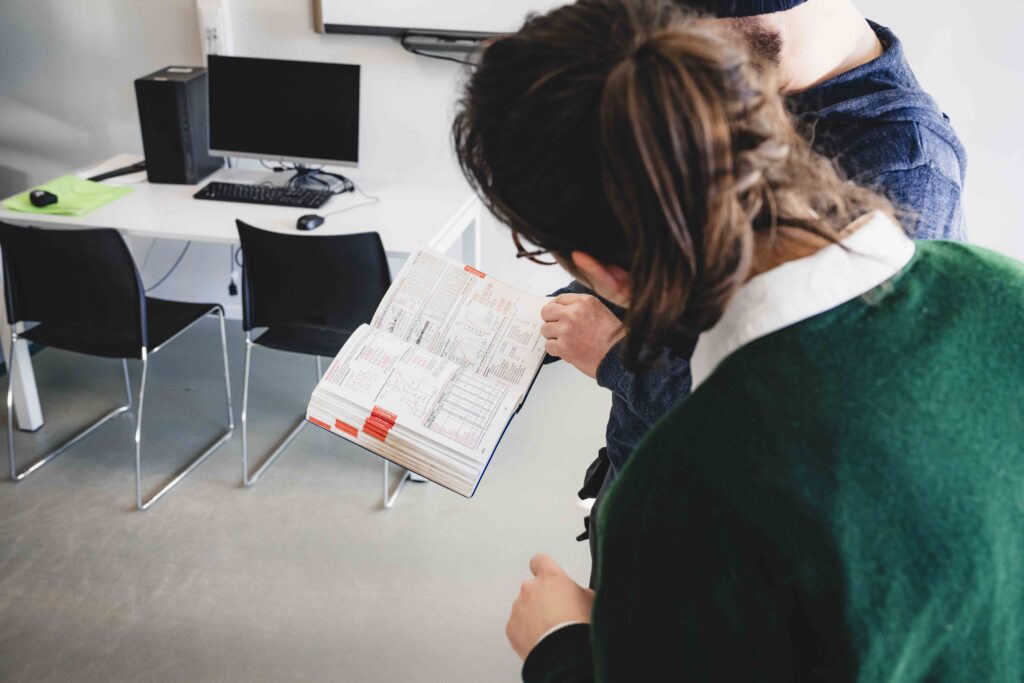
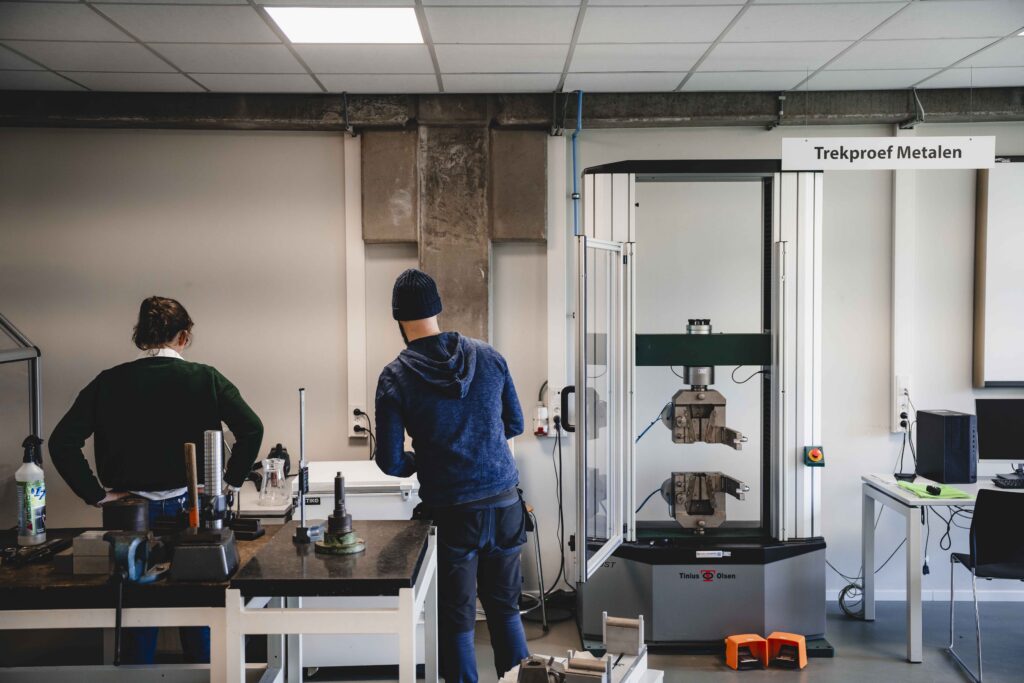
From measurement to interpretation: tensile and bending tests as a bridge between education and industry
The decision to place material testing at the centre starts from a simple insight: understanding material behaviour requires direct experience.
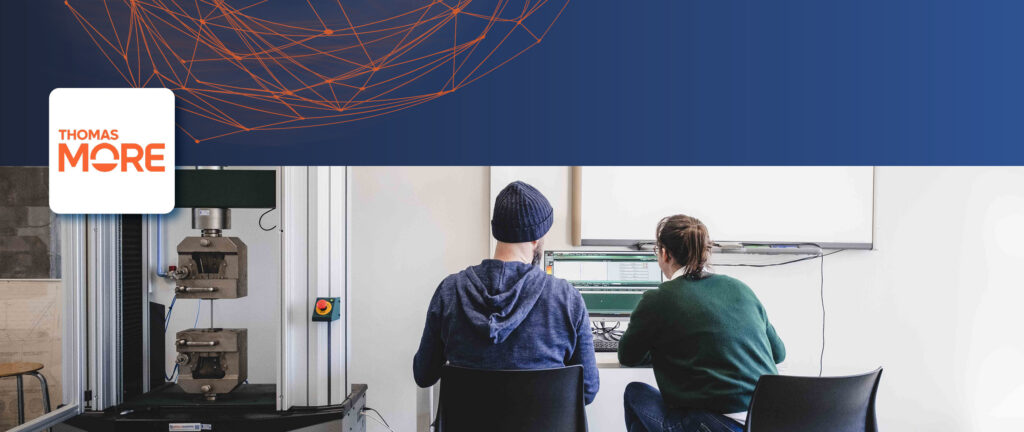
In the lab, students go through the full trajectory of a tensile test, from initial loading to fracture. They observe how a material behaves in the elastic and plastic region, and where it ultimately fails. This combination of visual and measurable data changes how they look at material data.
“What we notice is that students only start thinking critically when they see the test curve in front of them. They see that maximum tensile strength is not the value you design for, and that safety lies in what happens before that point.
You do not get that insight from tables, you need to see it and interpret it yourself.”
The added value is not in performing the test itself, but in the interpretation. Students learn to analyse a stress strain diagram, compare materials and explain deviations.
This shifts the focus from performing tests to technical understanding and making decisions based on data. This insight directly translates to design and quality control environments, where it is used to evaluate material performance and support design choices. An important part of this approach is the choice for industry recognisable equipment.
“We notice that students take much more initiative when they recognise something.
If a device looks and operates like it does in a company, they treat it that way. That has a direct impact on how seriously they take the measurements.”
For companies, this means graduates can be deployed more quickly and integrate more easily into existing testing environments.
Reliable tensile testing for education, QC and R&D
Discover how Thomas More uses the Tinius Olsen 100ST to provide students with reproducible measurement data, industrial test setups and hands-on experience in interpreting otensile tests.
From outdated setup to reliable tensile testing
The decision to implement the Tinius Olsen 100ST came after years of working with an outdated installation, a situation familiar to many laboratories.
Unstable software that was no longer supported, mechanical wear and reduced reproducibility led to inefficiency and started to impact the educational process. Practical sessions became dependent on whether the equipment functioned properly, putting pressure on the quality of learning.
“You do not want a lab session to depend on whether your machine works that day.
At some point you have to decide: do we keep repairing, or do we move to a system we can rely on?”
The transition to a modern tensile tester was therefore a necessary step to work again with reliable and reproducible measurement data.
The Tinius Olsen 100ST is an electromechanical material testing machine for tensile and compression testing, suitable for applications in education, quality control and R&D.
For Thomas More, this represented a clear step forward. Students now work with a system that reflects industrial reality, without complexity becoming a barrier.
Advantages
Reliable data
Consistent and reproducible measurement results
User-friendly software
Fast start-up and focus on interpretation
Flexible use
Suitable for different materials and test setups
Broad applicability
Education, quality control and R&D
“With a stable tensile tester, we can finally focus on what really matters: understanding the data.”
Collaboration with Benelux Scientific: support that makes the difference
In addition to the technology itself, the collaboration with Benelux Scientific also played an important role.
For Thomas More, it was essential to work with:
- a single point of contact
- fast technical support
- flexibility for adjustments and optimisation
In an educational environment, where practical sessions are scheduled and must take place, this support is crucial. Small optimisations, such as correct zero-load handling or proper grip alignment, make a significant difference in practice.
These short communication lines ensure that the installation not only works technically but also fits the educational needs.
The impact is clearly visible in the lab. Students understand faster what they measure, ask more focused questions and make connections with other applications more naturally. This results in better preparation for internships and jobs, and a smoother transition to industrial environments.
Want to learn more about tensile testing or the Tinius Olsen 100ST?
Do you work with tensile testing in QC, R&D, or a laboratory environment?
More info?
Request a demo or contact a specialist to discuss your application.
FAQ
A tensile test is a mechanical test in which a material is subjected to controlled tension until fracture, in order to determine properties such as yield strength, ultimate tensile strength and elongation at break.
The combination of accurate force measurement, reproducible test methods and user-friendly software ensures reliable results and efficient workflows.
Quality control, material research and technical education.
Students can focus on interpretation rather than operation thanks to reliable data and intuitive software.
The capacity of 100 kN allows testing of metals, composites and other technical materials.
Accuracy, reproducibility, flexibility, software and service.