At KU Leuven, one of Europe’s top research universities and Belgium’s oldest (founded in 1425), scientists are pushing the boundaries of sustainable chemistry and materials science. Within the Department of Chemistry, the SOLVOMET research group focuses on hydrometallurgy,exploring alternative, environmentally friendly methods to recover valuable metals from complex ores and waste materials.
In this context, PhD Student Carlos Arias-Quintero, a geo–metallurgist from the SOLVOMET group, currently works in extraction of lithium. The goal of his research is to develop innovative and sustainable methods for lithium extraction, a critical component for rechargeable batteries and the transition to clean energy.

Scaling up laboratory processes for real-world relevance
Carlos’s research aims to evaluate extraction from phyllosilicates, a type of mineral that is an alternative lithium source. However, transferring such processes to the lab presents practical challenges.
Early, the SOLVOMET group relied on small-scale reactors (25–50 mL), which were useful for screening experiments but too limited in volume and resistant material options for testing under higher scale conditions.
“Our previous setup allowed us to run three vessels at the same time,” Carlos recalls, “but they didn’t have PTFE inserts, so we couldn’t work with certain corrosive reagents. The BR-1000 allows us to perform experiments at a higher scale and safely use oxidizing or corrosive agents when needed.”
Carlos Arias-Quintero, PhD Student – Geometallurgist Department of Chemistry
The team needed a reactor that combined scalability, corrosion resistance, and precise control of pressure and temperature — key parameters in reproducing industrial leaching and hydrothermal reactions.

Overcoming limitations of control and reproducibility
Before the arrival of the Berghof BR-1000 reactor, the main bottleneck was temperature control and reproducibility. Their older Berghof system’s BTC controller was slow and outdated, making it difficult to maintain consistent reaction conditions.
“Before we acquired the new controller, it was difficult to reach the desired temperatures. Because of how the PID parameters worked, it took ages to warm up. Reaching the right temperature range could take most of the day.”
Such limitations hindered the group’s ability to compare their results with industrial references — a critical step when validating extraction processes that must match the chemistry of high-temperature, high-pressure operations.
“In chemistry, and especially when you try to replicate an existing process, you need to be as close as possible to the original conditions,” Carlos explains. “Since some processes we are replicating operate at high pressure and temperature, precise control is essential for meaningful conclusions.”
The Berghof BR-1000 reactor: a robust solution for scalable experimentation
To meet these challenges, KU Leuven selected the Berghof BR-1000 reactor, a 1-liter system equipped with an electric heating mantle and the BRC controller. This combination offered the scalability, chemical resistance, and control capabilities the team required. Carlos emphasizes that he joined the research group after the initial purchase, but he quickly saw why it had been the right choice:
“Compared to the smaller equipment we had, the decision was mostly about scale — being able to run larger volumes under controlled conditions and with the right materials.”
The BRC controller proved to be a game-changer. Its intuitive touchscreen interface, precise feedback control, and programmable heating profiles enabled faster, safer, and more reproducible operations.

“In the new configuration, I’m particularly fond of the pre-heating and cooling functions,” he says. “Before, similar experiments took up to 24 hours between heating and cooling. Now, the entire run takes about five to six hours — a fourfold gain in efficiency.”
Better reproducibility, higher efficiency, and safer operation
Although data analysis is still ongoing, the early results are promising. The Berghof BR-1000 has already demonstrated its value in reproducibility, process control, and operational safety.
The new system’s automated pressure control — replacing a manual manometer — has improved precision in setting and monitoring pre-pressure levels, which is essential for maintaining tight seals in PTFE-lined vessels.
“Now we can really know if the pre-pressure we’re reading corresponds to what we expect,” Carlos explains. “It’s always on point, and the automated system makes it easy to stop safely if something unusual happens.”


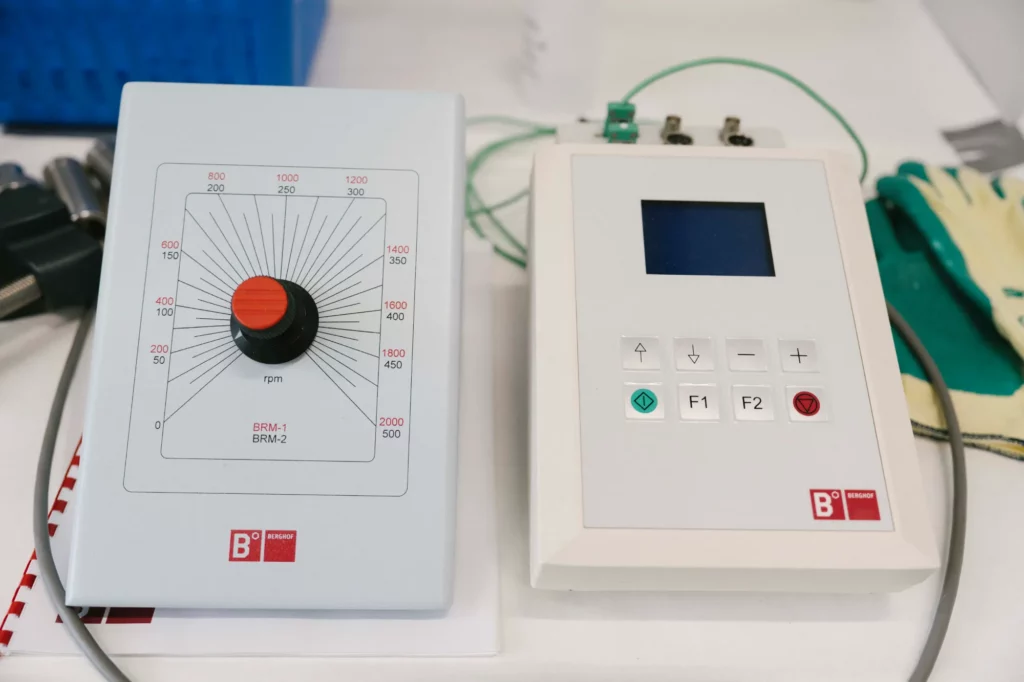
The improved control has also enhanced the quality and comparability of experimental results, allowing KU Leuven’s team to replicate industrial processes with greater confidence.
“In a current project, we were able to replicate a patented process for lithium extraction” says Carlos. “Even though our setup is batch-based rather than continuous, the results align very well with expectations — that’s a real success for us.”
Reliable collaboration with Benelux Scientific
For Carlos, one of the most appreciated aspects of the project was the collaboration with Benelux Scientific, whose responsiveness and follow-up made a clear difference.
“Benelux Scientific provided us with a proof unit of the new BRC controller so we could test it and see the improvements,” says Carlos. “They also arranged a re-training session, because expertise in using the system had been lost over time as people came and went from the group.”

Furthermore, Benelux Scientific played a crucial role during the selection and evaluation phase by supplying a demo unit of the BRC controller for several months. This allowed the research team to test and validate the system before committing to the investment.
If you’re interested to know more about the Berghof reactor and its applications for metal extraction research, please contact our product specialist Steve Bruers.
More info about Berghof reactors?
For further information, please contact our product specialist Steve Bruers.